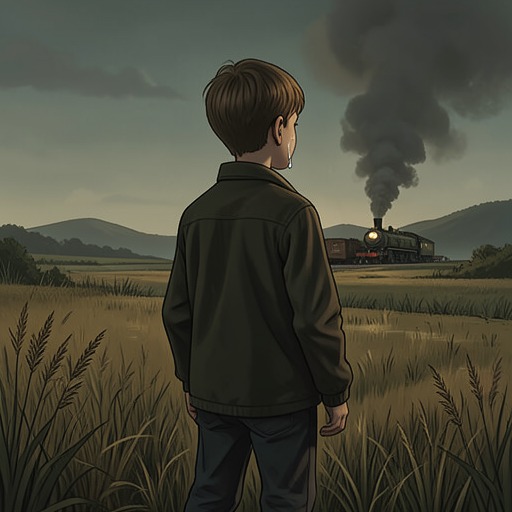
“Do not cry”
The Tiger Rising“Do not cry” is the rule Rob learns after his mother’s funeral, and the phrase becomes a recurring measure of how he and his father handle grief. It begins as an attempt to stop a child’s sobbing, hardens into Rob’s practiced self-silencing, and finally gives way when father and son acknowledge that they both need the mother who is gone. The expression’s significance lies in that change: what first enforces isolation becomes part of the history they can face together.
Origin at the Funeral
At the funeral, Rob is overcome by heaving sobs that hurt his chest and stomach. His father stands beside him and begins crying too, but then slaps Rob to make him stop. The blow tears a hole beneath the arm of his father’s too-small suit jacket. Afterward, his father says, “There ain’t no point in crying,” and explains that crying will not bring her back. The injunction is therefore born from a moment that contradicts its own lesson: father and son have both been crying, yet the father responds by suppressing the child’s grief.
The torn suit becomes inseparable from the command. Six months later, whenever Rob’s father extends a hand to someone, Rob notices the place where the jacket split when his father slapped him. He remembers the scene’s instruction as “Do not cry. Do not cry.” The phrase is no longer only the father’s spoken advice; it has become a repeated thought attached to a visible reminder of the funeral and the violence used to end Rob’s sobbing.
A Rule of Self-Suppression
After the funeral, Rob and his father move from Jacksonville to Lister. Rob does not cry again during the six months that follow. His silence becomes a practiced ability, especially when Norton and Billy Threemonger bully him on the bus. They grind knuckles into his head and punch his arm, while the driver pretends not to notice. Rob endures the attacks without crying, regarding himself as exceptionally good at not crying. The pattern makes emotional restraint look like protection, even as it leaves him alone with both bereavement and present humiliation.
Rob also describes his inward restraint through the image of an overfull suitcase: he stuffs his feelings inside, sits on it, and locks it shut. He has packed such a suitcase before, when he and his father left Jacksonville after the funeral. The tiger becomes something he can place on top of it, giving his attention a new focus without undoing the underlying grief. In this context, “Do not cry” belongs to a larger practice of not thinking about painful things: the command helps keep the emotional contents shut away, but the image of the full suitcase suggests how difficult that containment is.
The Command Under Pressure
The prohibition appears most effective when Rob faces pain that can be endured without speaking. During the bus attack, he tells himself he will not cry and draws strength from thinking about the tiger. His composure frustrates Norton and Billy, who are accustomed to tormenting him. Yet this success is limited: the bullying does not stop because Rob has become safe, and his silence does not resolve the loss that made crying forbidden. The phrase marks a survival strategy, not freedom from suffering.
Its emotional cost is also embedded in the memory that returns. Rob’s father’s words present crying as pointless because it cannot reverse death; Rob’s repeated inward command carries that reasoning forward as a rule for himself. The repetition links the funeral to the present without requiring Rob to speak openly about his mother. What he cannot yet express directly persists in the torn sleeve, in his refusal to cry, and in the pressure of what he has locked away.
Breaking the Rule Together
The command loses its hold when Rob buries his face in his father’s shirt and says that he needs his mother. His father answers that he needs her too, but that neither of them has her; what remains is each other, and they must learn to make do with that. Rob still insists, “I ain’t going to cry,” and shuts his eyes, but tears escape and then come in a rush. The old rule is voiced at the very moment it fails.
Rob’s crying comes from the deep place where his mother had been, which he connects to the place where the tiger had been and is now gone. This comparison gathers the losses without making them interchangeable: grief for his mother and sorrow over the tiger occupy the same inward depth. His father wipes tears from his own eyes and holds Rob close, telling him that it is all right and that he is okay. Unlike the funeral, when his father’s slap stopped the crying, this time his embrace makes room for it. The recurring phrase thus changes from an inherited prohibition into evidence of how long Rob has kept grief contained—and how its release becomes possible when his father shares, rather than denies, the loss.